Exploring Life After Life Through Hypnosis
A Journey Within Beyond the Physical
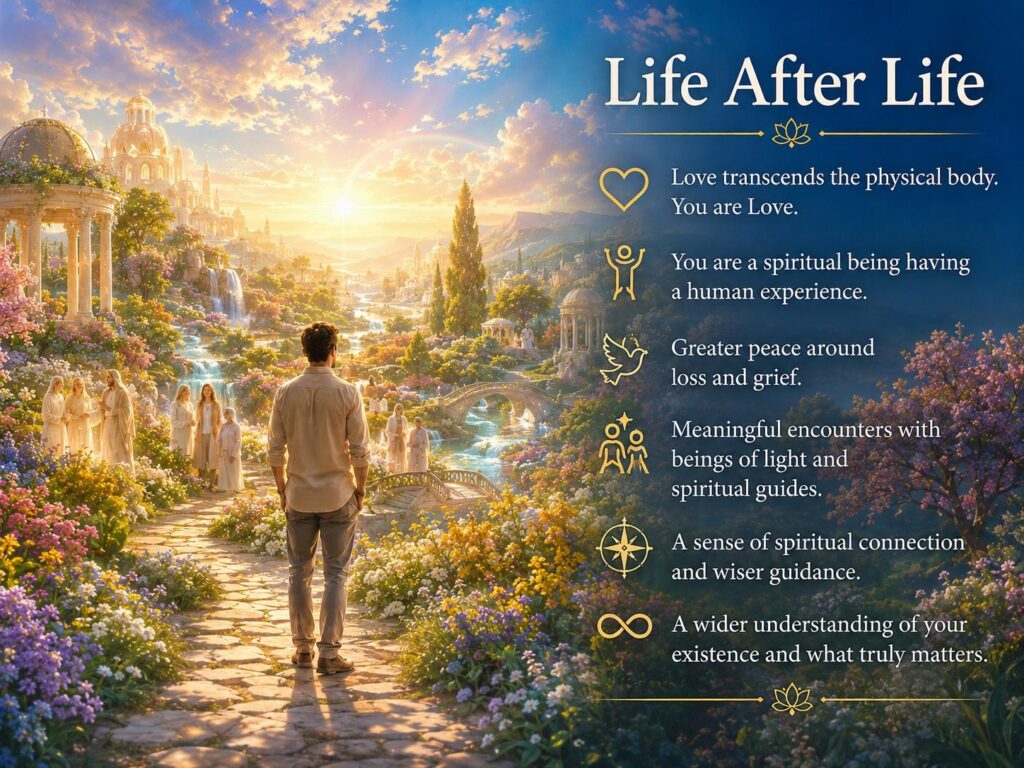
For many, the possibility that consciousness continues beyond physical death speaks to a part of the heart that words do not easily express. It becomes deeply personal after the loss of someone you love, during a spiritual moment that transforms how you see existence, or through a quiet sense that love and the bond shared with somebody close to you are not limited to what can be seen or touched. In those moments, Life After Life is more than a reflection on what follows death. It also considers the meaning of existence, consciousness, and the possibility that who you really are transcends the physical body.
From this perspective, you are more than your physical existence, a spiritual being living a human experience. Your body, name, relationships, roles, and your own history belong to the life you are living here, yet they do not necessarily define who you truly are.
Seen from this wider view, the longing takes many forms. Perhaps you want to feel closer to someone who has passed away, look at a loss from a different perception, consider whether consciousness continues after physical death, or seek inspiration and guidance from what you perceive as a wiser companion, guide, ancestor, angel, or being of light.
What your heart longs for is not always an answer. The longing is for meaning after an event has altered your life, reassurance after loss, a sense that love has not vanished simply because a body is no longer here, clarity when the path ahead feels uncertain, or a different way of seeing what fear, grief, and the concerns of everyday life have made difficult to make sense of.

What comes forward is different for everybody. You may have the impression that someone you deeply loved is close to you. At another moment, an ancestor, guide, angel, being of light, or guiding figure is part of what unfolds. Images, words, symbols, memories, emotions, or a quiet inner knowing enter your attention with a significance that feels profoundly intimate.
What stays with you most strongly is not always what you see, but what accompanies it. For some, peace is felt where fear had been living, love meets the emptiness left by absence, and a feeling of nearness emerges where separation had seemed final. A quiet realization gives form to what ordinary thought had never been able to grasp.
You might also sense a wiser presence revealing a broader perspective on what you have been carrying. A relationship takes on new significance, a painful choice is viewed with greater wisdom, an old concern loses some of its urgency, or what once seemed impossible to make sense of takes on a different significance in the story of your life.
There is no need to force an explanation for any of it. What surfaces may hold spiritual significance for you, while symbolic, psychological, and subconscious interpretations are equally possible. Life After Life does not require you to turn an inner impression into proof of what exists after death.
What matters is what it stirs in your heart, the meaning it brings into the life you are living now, and whether it supports you as you move toward greater freedom to choose again from love, peace, and trust.
For someone living with grief, sensing a loved one near you often gently softens the ache of absence, while a memory, message, image, or feeling of love may transform how goodbye is held in your heart.
Sadness does not need to disappear for what was shared through love to still matter. Moving forward with your life does not mean leaving somebody you loved behind, and remembering does not require staying bound to the pain of losing them. The daily companionship is gone, yet what was shared through love is not erased simply because they are no longer physically beside you.
What was shared through love can still be felt in the meaning that loved one holds in your heart. From there, attention widens from the loss itself to the life unfolding before you, and what began as wondering about what follows this lifetime illuminates what matters while you are here.
A Wider View of the Life You Are Living
Considering the possibility that physical life is not the whole story can reshape the meaning of being here.
This is where Life After Life quietly meets the heart of Your Journey Within. What first drew your attention to the possibility of life after death now guides you more closely into what has been shaping your life today. Subconscious beliefs, emotional associations, memories, and inner conclusions come into view as influences on how you see yourself, receive love, trust others, protect yourself, and respond to what is in front of you.
Painful moments leave more than memories. Rejection can leave behind the belief that you are not worthy of love, abandonment the expectation that those you love will eventually leave, criticism the conviction that you are not enough, betrayal a fear of trusting again, repeated neglect the conclusion that what you feel does not matter, and a frightening event the sense that you always need to protect yourself.
Such conclusions form while you are trying to make sense of pain with the emotional resources you have at that point in your life. They are not necessarily truths about who you are. They reflect the meaning given to what was taking place and what you needed in order to live through it.

Even after the event ends, the belief may stay active beneath everyday reactions. Years later, its influence appears in relationships, expectations, emotions, choices, and automatic patterns without making its origin obvious. What is happening today activates a conclusion formed long ago, and yesterday quietly enters today.
As the difference between what happened and what you came to believe because of it becomes clearer, you begin relating differently to that old story. What you once accepted as a truth about yourself can reveal itself as an interpretation formed during fear, rejection, grief, abandonment, shame, or pain.
From there, transforming subconscious mind content is not about denying what happened or forcing yourself to think differently. It is about changing the meaning a past experience has carried, transforming beliefs that do not support the life you want to live, reframing emotions that still carry the weight of the past, and creating greater freedom in the present moment to respond to what is actually here rather than reacting from old beliefs, emotions, and conclusions stored in the subconscious mind.
Everyday moments feel increasingly precious. Time with somebody you love takes on greater significance, and words left unspoken seem important to express. Grief makes space for gratitude. Fear releases its grip as trust strengthens. Doubt eases while inner certainty develops. Separation gradually gives way to belonging, resentment diminishes, and you live with greater peace.
With this wider view, what follows physical life is no longer the only focus. Your attention turns toward the life in front of you and to what truly matters while you are here. Love is expressed more freely, fear has less influence over your decisions, and what belongs to yesterday no longer needs to enter the present moment. Your choices begin to reflect your principles, your life purpose, and the way you want to live. The transformation becomes visible in how you meet this life, with greater presence, freedom to choose again, meaning, and an open heart.
As an old interpretation loses its hold as unquestioned truth, the emotional burden around it is met differently, which naturally leads into forgiveness and letting go.
Forgiveness and Letting Go
Forgiveness does not mean approval of what happened. It does not dismiss somebody else’s actions, remove responsibility, require reconciliation, ask you to reenter a relationship that is not beneficial for you, or require you to forget.
At its heart, forgiveness is releasing the emotional burden that has stayed with you because of what happened. When someone else has hurt you deeply, the event itself belongs to the past, yet anger, resentment, mistrust, sadness, disappointment, or grief can still enter the life you are living today.
Forgiveness means that what was done to you does not need to occupy the same place in your heart. Remembering does not have to mean reliving, and acknowledging the hurt does not make it the definition of who you are. The wisdom stays with you while some of the emotional weight is released, and the choices that caused the pain belong to the one who made them while you decide what deserves to move forward with you.
Forgiveness does not make the past insignificant. It reshapes the influence the past still holds over your life, not because what happened did not matter, but because your peace matters too.
Yet forgiveness is not only about releasing what you have held because of what another did. There are also wounds that turn inward, leaving you blaming yourself for what happened, for what you did or did not do, or even for how long you have held the pain. This is where self-forgiveness reaches a more intimate place.
Self-forgiveness becomes especially tender when pain has been turned against yourself through blame, shame, guilt, anger, sadness, or thoughts that you should have known more, chosen differently, left sooner, spoken sooner, protected yourself more, or somehow been able to prevent what happened.
It also includes forgiving yourself for how long you lived with what hurt, how deeply you believed the conclusions formed around it, and how those beliefs influenced your choices.0 For years, perhaps you believed that you were not good enough, that you were alone, unwanted, unlovable, dirty, without value, powerless, stuck, unsafe, or that you did not belong. You may also have believed that your feelings did not matter, that love had to be earned, that pleasing everybody was necessary in order to be accepted, or that there was something fundamentally wrong with you.
Those beliefs were not chosen because you wanted to suffer. Many formed while you were trying to protect yourself, belong, make sense of pain, or find a way through what you were living with the emotional resources available to you at that time.
Self-forgiveness includes releasing the judgment for having carried pain, anger, sadness, guilt, shame, or limiting beliefs for as long as you did. It means looking back without demanding that the version of you who lived through that period have every insight and inner resource you have now.
There may also be choices you look back on with regret or moments you wish had gone differently. Self-forgiveness gives you space to acknowledge them, make amends where appropriate, and choose differently moving forward. As self-judgment begins to soften, the past can take on a gentler meaning instead of becoming something you continue using against yourself.
As forgiveness begins to loosen the emotional weight that has stayed with you for so long, letting go does not mean pushing emotions away. Instead, you begin relating to them differently, and opening your heart to Love becomes a natural part of that same movement.
Opening Your Heart to Love
Opening your heart to love means meeting what you feel without suppressing it and without immediately turning the emotion into an action.
This means feeling anger without becoming cruel, acknowledging fear without letting it decide the direction of your life, experiencing sadness without making it the meaning of everything around you, and holding grief tenderly without shutting Love out.
When an emotion comes forward, staying with it long enough to notice what it is pointing toward often reveals what the reaction has been protecting. Anger frequently covers hurt, and the need to control protects fear. Resentment may hold what never felt acknowledged, while withdrawal often guards an old belief that closeness leads to pain. Jealousy can reflect the fear of not being chosen, and a continual need for reassurance is frequently tied to the expectation that love will disappear at any moment.
You do not need to suppress what you feel, and you do not need to act from everything you feel. You give the emotion space while listening to what it is showing you, recognizing the belief, memory, fear, or need connected with it, and still choosing how you want to meet the moment.
Opening your heart to love does not mean turning away from your pain, minimizing what happened, or pretending you are unaffected when your heart is hurting. It does not mean accepting harmful behavior, abandoning boundaries, or forcing yourself to love somebody who has caused you pain.
Opening your heart means giving emotions space to be present without suppressing them, trying to get rid of them, or turning them into words and actions. You remain with what is happening as the emotion moves through in its own time, while keeping the freedom to choose how you respond.
Sadness can be there without taking over everything around you, anger can pass through without determining what you say or do, and fear can arise without making the decision for you. The emotion is given space without becoming the one directing your life.
Opening your heart means that pain does not have to close you off from love. Sadness is given space without becoming the whole story, anger is felt without becoming the one making the choice, and fear is acknowledged without handing it authority over what comes next.
Opening your heart to Love is not about creating Love or trying to become more loving. Your True Self is Love. As old fears, judgments, defenses, and conclusions lose their influence, what has always been there is expressed more freely in the way you relate to yourself and others, establish boundaries, forgive, receive love, and meet what life places before you. From there, you have greater freedom to choose again, responding in the present moment to what is actually here rather than reacting from what belongs to the past.
This space between emotion and action opens naturally into the freedom to choose again, an essential part of Your Journey Within.
Where Your Journey Within Becomes the Life You Live
Freedom to choose again becomes possible as emotionally burdensome feelings have been reframed and limiting beliefs have been transformed. As old reactions lose their influence, you begin to meet what is actually happening without automatically interpreting it through conclusions formed in the past. A boundary can be established without resentment, a no can be expressed without believing it makes you unloving, closeness can be received without abandoning yourself, and uncertainty can be faced without expecting yesterday to repeat itself. Life will still bring emotions, challenges, and moments that ask something of you, but they no longer need to be met through the same patterns that once directed your reactions. You have greater freedom to respond consciously and choose what reflects who you truly are.
As emotionally burdensome feelings are reframed and limiting beliefs lose the influence they once held, something deeper becomes possible. You meet life more consciously in the present moment, with greater freedom to choose again rather than letting the past determine what happens now. As what has obscured your True Self gradually falls away, you return to what has always been there: Love, Joy, Peace, Stillness, and Wholeness. Your choices begin to arise more fully from who you truly are, bringing your principles, your life purpose, and the way you live into closer alignment with the life you are meant to live.
Life After Life often begins with curiosity about what may exist beyond physical death, a longing to feel close to someone you love, a desire for spiritual guidance, or the wish to see existence from a wider view. Yet what begins as a question about what may come after this lifetime can gradually illuminate the life before you now. The possibility that consciousness extends beyond the physical body can bring a different appreciation for time, relationships, forgiveness, the words you still have the opportunity to express, and the significance of how you choose to live while you are here.
“Life After Life may bring a wider understanding of your existence, greater peace around loss, and a deeper sense that Love transcends the physical because Love is what you are. From that understanding, you can live more fully in the present moment, open your heart to Love, and experience greater freedom to choose again by making conscious choices that reflect your principles, your life purpose, and the life you are meant to live.”
Your Journey Within
- Free to choose again in the present moment.
- Opening your heart to Love.
- Returning to your True Self, and returning to Love.